
Where the need is greatest. The help is nearest.
We live in a time of radical pushback against the idea of expertise.
Not just that the person in front of you isn't an expert but that experts don't exist in general.
Partly it's the utter frailty of the personal statement in the modern age.
Everyone speaks in uncaveated declarative sentences and most aren't experts in the thing they are declarativing so those statements fall apart like an amateur croissant.
If most of the the statements you encounter in the wild fall apart easily, one starts to get wary of all statements.
And; in American culture we hate credentials. We hate anyone who keeps the letters after their name or mentions that they have been at a prestigious or definitive institution for decades. That standard limbic response is a Biff Tannenesque "WHAT YOU THINK YOU'RE BETTAH THAN ME?!"
And; having acquired specialized knowledge, being able to synthesize new understandings of that knowledge, and successfully communicate that new understanding has little respect in an moment where the sum total of human knowledge is accessible and one can imagine a time in which one will absolutely get around to reading it so we're all basically the same. In much the same way that many American's are just temporarily inconvenienced billionaires - most are just not-yet professors.
The downstream impact is that we have lost all sense of what it is to have expertise. We have lost all sense of what actually having specialized knowledge looks like. We have lost all sense of what "common" means when applied to sense. In that we don't respect knowledge we label whatever knowledge we have as dead average and everyone should know it.
In other news. I am currently performing in my first musical since graphical browsing went mainstream.
In my last show I kissed a woman and danced for the first time in a generation.
On my tour of things I haven't done since learning of Newt Gingrich's existence on this physical plain: a musical.
LET'S GO.
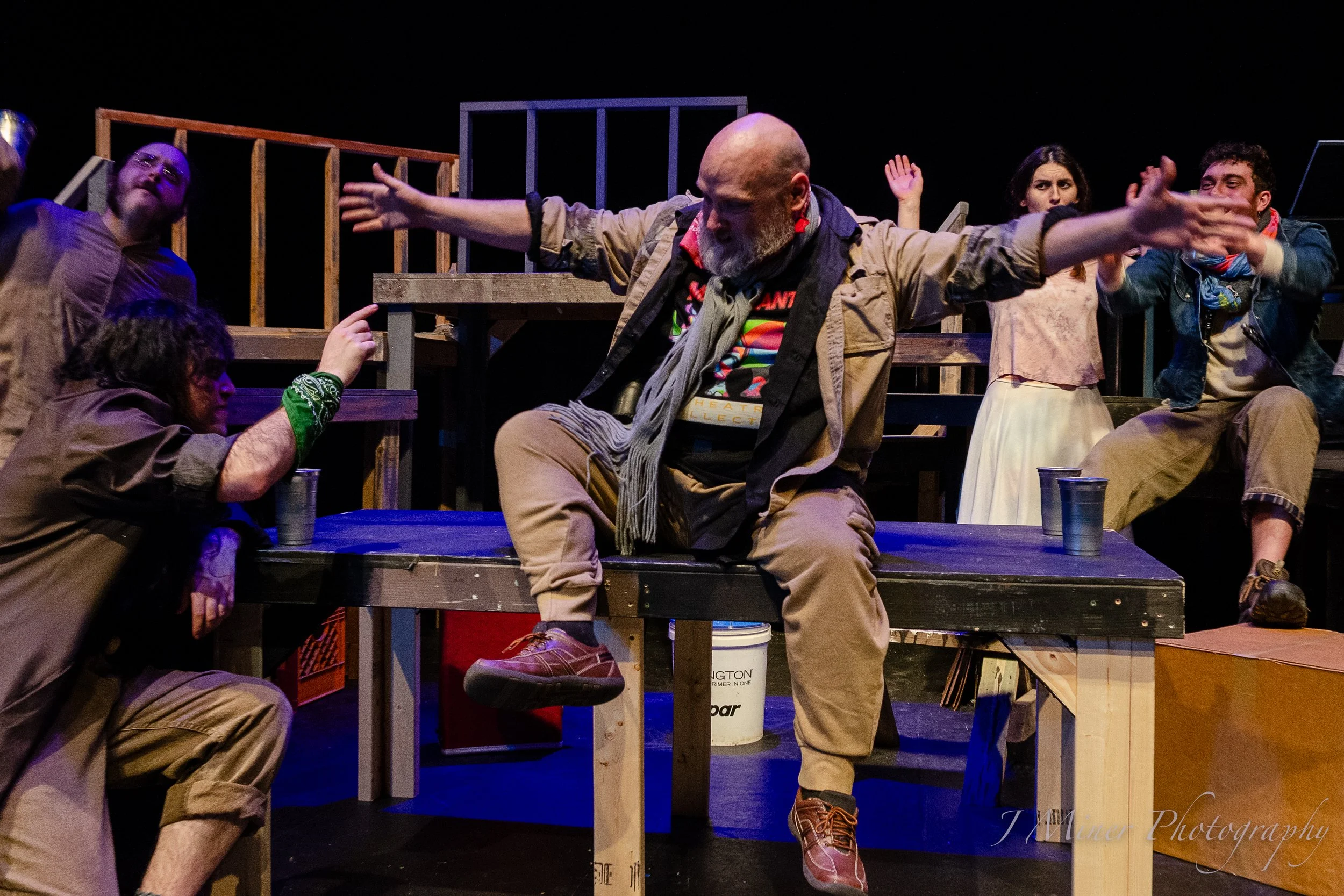
Photo by Jon Minor
I'm performing in the ensemble of The Threepenny Opera for Mercury Players at the Bartell Theatre here in Madison.
Part of why I chose to audition for it over auditioning for Measure for Measure for my good friends at Madison Shakespeare Company, which is performing in the same time slot in the black box down stairs, is that I wanted to learn more about how to use my singing voice. I have a very trained stage voice, and a basically stock retail singing voice. I have no knowledge of music at all and fewer instincts around music. I'm basically a rock with lips in this arena.
In my dream world, with two months lead up we were going to have time for me to learn somethings from the team and my castmates and get some flight time with the music to improve my singing muscles and practice. In my real world, the musicians and I don't speak anything like the same language. We work off different paper even. Musicians don't show up for the two months, they show up for game time, and the expectation is that you already know the sport.
Because OF COURSE IT IS.
The expectation is that one who signs up to do a musical speaks musical. And there is no production protocol for teaching the aliens who don't. This isn't school.
They are experts in their field and fundamentally don't understand that they are speaking a different language entirely.
And here's the thing.
As practitioners we do this to everyone. All the time.
It's been a long time since I've been in a practitioner group that was outside my practice. I haven't experienced this feeling in my memory. Even learning puppeteering wasn't entirely foreign. Music 100% is.
Practitioners speak in jargon.
We speak in shorthand.
We speak in acronyms.
We speak in in-group anecdotes to illustrate a point.
We speak in academic terms about plays no one has read.
We expect that everyone has read the entire canon (as defined by us, today)
And we believe of course that we are being understood. Because my knowledge is common knowledge and everyone should share it.
Even when one understands that one's knowledge is deeper than "common" the line that one draws for what everyone else is going to understand without additional effort on our part is always higher than the actual level of understanding. My average post-show-nod-and-pretend-you-get-it response from folks is VERY high. I am among the jargoniest jargoners who ever jargoned and I torture syntax when I'm not tired.
And then on top of that one does something like Shakespeare. Which is of course universal but in its depth becomes a niche.
Perceptionwise - my friends all are doctors of Shakespeare, masters of Shakespeare, professional interpreters of Shakespeare - I'm just a loud dude who does Will Kemp cosplay on hills in Wisconsin.
Because being an expert means being like them. Having a Shakespeare badge or having authored a book. Because the American ideal is always being the 6/10 just above average.
That I've performed half of Shakespeare - a bunch of it FOR them - doesn't enter my mental math when I total up my expertise.
But being a 6/10 talking to what are clearly 3/10s doing their first Shakespeare I don't need to go out of way to explain to them any of the things I'm talking about as we're becoming acquainted with each other and the text. They'll pick it up via context clues. Eventually. In 5 weeks.
Folks we need to be the leaders the community needs. And you don't need to be quite as grey bearded as I am for leadership duties.
It's not ego to know when you know something and share the knowledge.
Share the knowledge in clear non-jargon.
Without judgement for what people don't know.
Especially here in the heart of community theatre.
Your knowledge not being celebrated doesn't mean it's common and your teams will always perform better the more shared wisdom it has.
You've been in production processes - there is no reasonable expectation that those at the top of the production process have time to teach.
[unless that's the point of the production which is a whole other post]
Where you have the capacity, make time in the process to share what you can with folks and make it clear that you are available for questions.
And then be available for questions.
Your expertise may be in the restaurants that have the quickest turnaround for dinner on a show night, or which theatre water fountain is the coldest. Or it may be on ways to lock in on the music shifts that you're using to cue into the next beat.
But don't wait until you feel like an expert to share what you know today.
