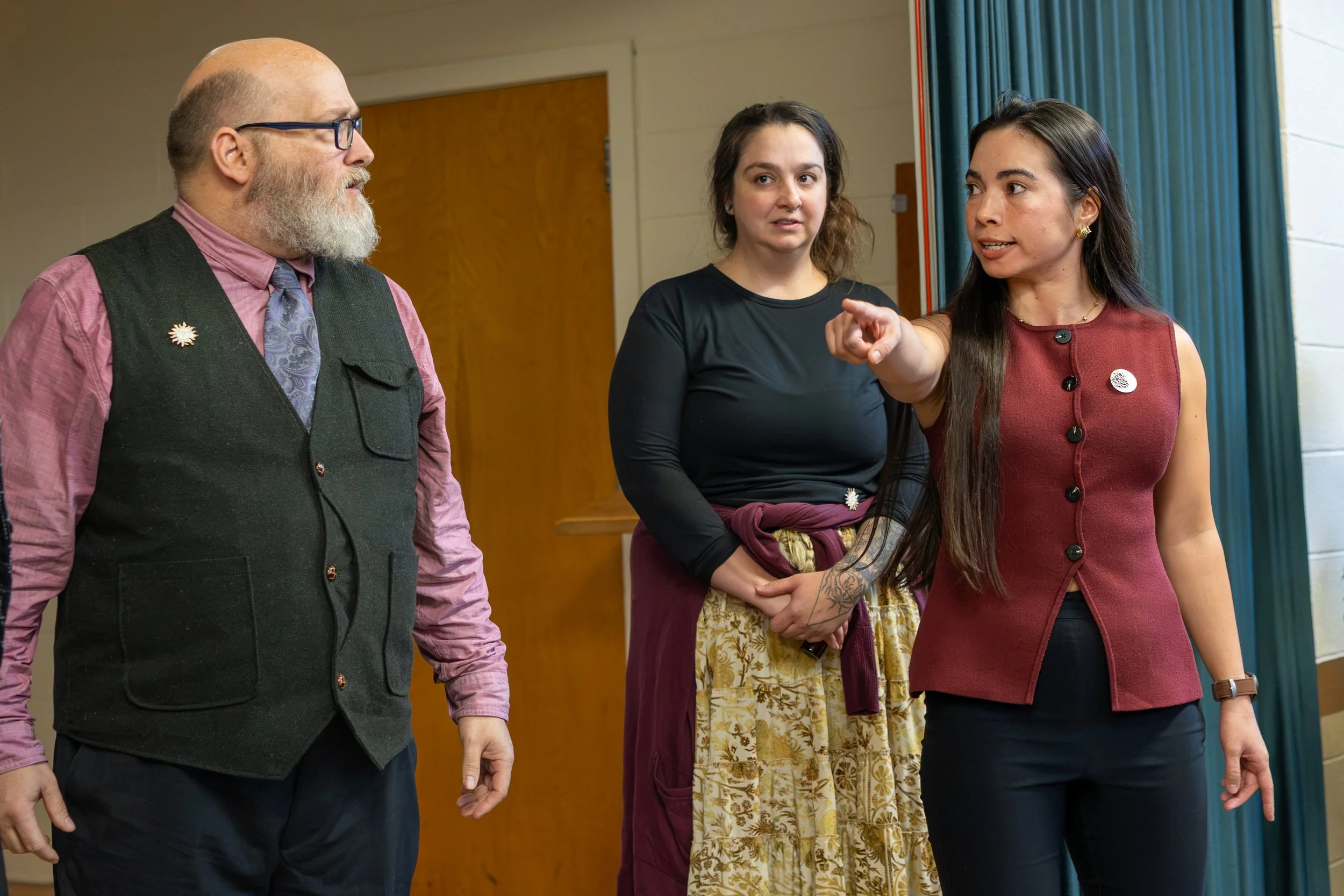
A Story Now Ours
Before this month I had never done an immersive show. Due to the aggressive repeat players at more popular productions I am honestly turned off of going to most immersive shows. But immersive theatre has been a consistent presence in our home since my wife Megan’s exposure to that world with Sleep No More in 2011. She dove deeply into the form and is a published expert.
I think that the form is an important edge of the live performance universe. There are audiences that, in order to achieve the responsive empathy many associate with live performance, require some manner of agency or to be loosely contextualized as a performer. If you are looking to grow your audience beyond the cohort you grew as a presentational production company you have to offer a different experience. Immersive is a fantastic way to do that.
Most community and semi-pro level theatre groups would never attempt immersive because the most-known models are unthinkably expensive and require time and talent beyond the reach and resources of small groups. So when Starling Immersive reached out about participating in The Ritual I knew that I wanted to be involved. If they had the intestinal fortitude to make the attempt I wanted badly for them to succeed. The best way to ensure a project succeeds is either to hire the best talent available or talent that won’t require energy from you so you can use it elsewhere. I am the king of wind him up and let him go.
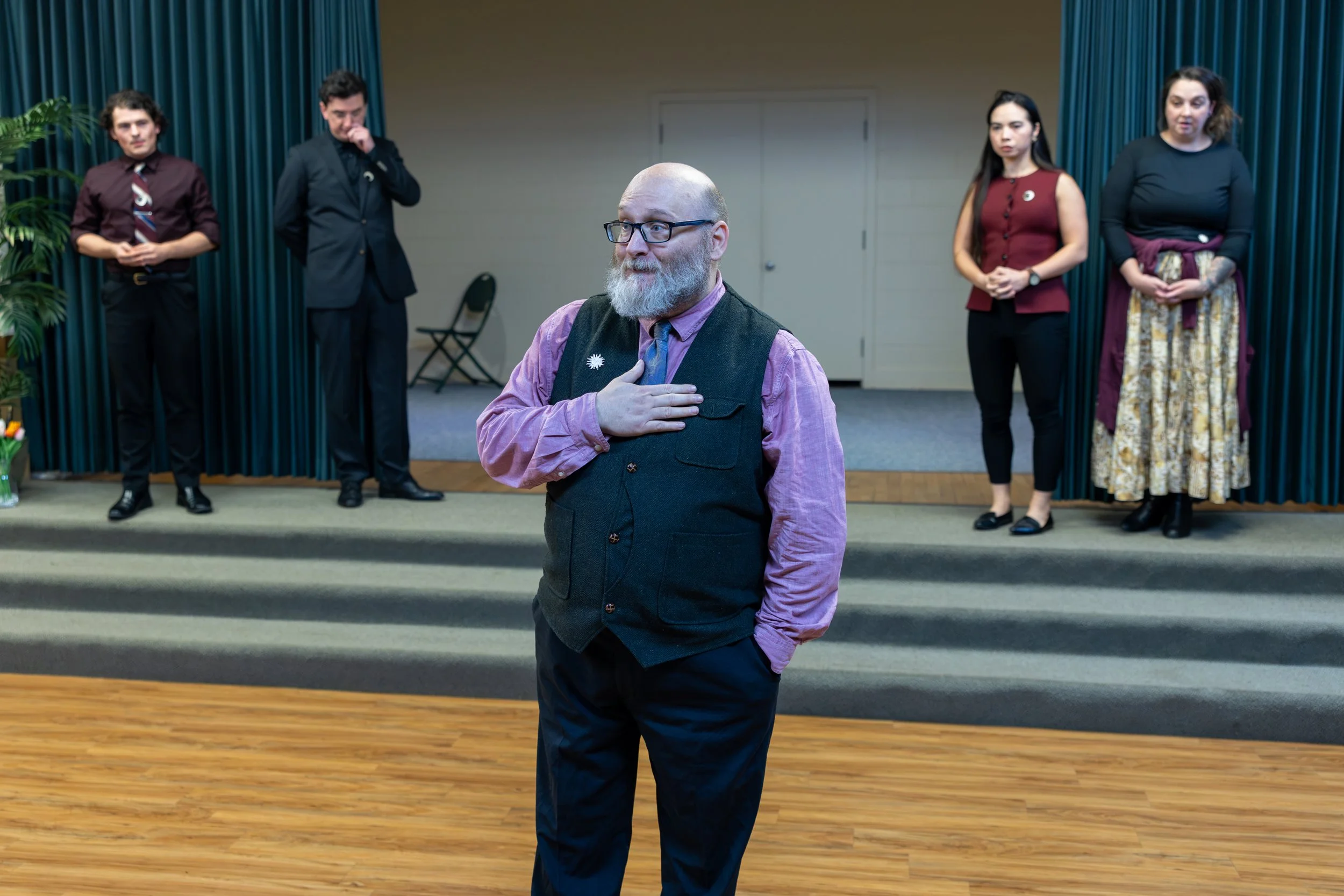
Travis Bedard with the cast of The Ritual written and directed by Kyla Vaughan. Photo by Steve Noll
Of course my first foray into immersive performance - aside from a month as a premium scare attraction in Minnesota - was going to be for a brand new community theatre doing their first show. I love taking the easy path to impressing my wife. What I knew I wanted to accomplish on a base level was to get the audience members to have a True Moment of Vulnerability. I consider it the best thing that could happen in an immersive show. A moment of getting an audience member in a 1:1 or in a 1:few grouping sharing something truly vulnerable.
The primary hurdle for me to achieving that, beyond lack of experience of course, is that the primary mode of performance in an immersive show with high audience agency is improvisation. I’m very very bad at improvisation. This is not me being self deprecating. Improvisation is not a skill I possess. I have a whole bunch of aphantasia which means I don’t have a plan for where this scene is going. What could go wrong?
The Ritual
The Ritual is a show about a local community group - Ex Morte Lux - opening its doors to largely unvetted and skeptical guests - in a bid for broader acceptance regionally and nationally. Ex Morte Lux believes that beauty, the spark of connection between each person and another or each person and the world, is the root building block of society. They believe that sharing, spreading and creating that beauty will eventually create the structure that will free society from the frictions that lead to selfishness and violence. As the group has grown and as The Alchemist has gained power there has been a greater emphasis on finding ways to harvest the benefits of shared beauty at scale and speed and to broaden the effect of renewal that it can bring more quickly, predictably. and sustainably.
This has led to the process of developing the Ritual.
Leadership of the group was also seeking a slightly adversarial audience to be present when their long gestation renewal process succeeds, so the miracle of it isn’t simply the claim of a unrespected fringe group. During the evening the Devoted of Ex Morte Lux and their leader offer as many secrets of their daily practice as they believe that they can to non-members, while trying to hem in what the guest can share outside the room.
They share their budgets and goals, their daily practice, some hopes for the future, and part of the blend of science, magic and hope that undergird the next generation of practice for the group.
The fault lines between the full dedication and commitment to sacrifice needed to move the group and the world towards true healing - and the fear and skepticism of those not yet healed from personal hurt become evident over the evening. As guests poke and pull at those fault lines over the course of the evening they may change the balance of the group and eventually how the Ritual proceeds.
So. What were my goals for the Ritual?
Make the Leader incredibly relatable.
Whatever the mechanics of the (not a) cult evolved into it was important to me that the characterization of the Leader not achieve Royal Remove.But also probably Not Okay.
Given the relative predictability of size and shape of the audience I wanted to steer the construction of the (not a) cult to something that would be seductive for the expected audience.
Evangelize.
We wanted to make sure that as many people as possible got the 1:1 experience. That was going to mean hitting 4-5 minute turns on those scenes.
I wanted a chance to have a formal story telling moment.
I wanted a chance for multiple audience members to get to leverage our audience to tell stories.
I wanted to not be so awkward in my improvisation that it felt like a bad first date.
How did I do?
I am about to say a number of negative things around an incredibly successful show. The negative things are notes to make my contributions better not about a failure of the overall show. The show worked very well, and was improving wildly every night as a very raw group of immersive performers learned mechanics in general and the mechanics of THIS show better every show.
Every night The Devotees of Ex Morte Lux got clearer at signposting both key information and actions to ease audience transition from passive to active in the evening. Every night the use of those mechanics and moments got more muscular in trying to help the audience change the ending. Audiences had a VERY good time when we steered them into involvement they felt confident was the intended involvement.
Make the Leader Relatable?
I nailed this. The Leader was approachable and and guests felt comfortable challenging him and his low-stake orthodoxy. There was absolutely a professorial uncle there that audiences engaged with.
But also probably Not Okay.
I did not in fact nail this. Given my time management and structural problems I never found the time to drop the Unhinged Thing into conversation that would let folks know that the reasonableness The Leader was grounded in has a break point that was probably dangerous. Maybe next lifetime.
Make the community seductive
This went well. I knew that the group was going to be self selecting for believing in the utility of story and for (in general) believing that general positivity and community are workable paths.
Evangelize
I mapped the community and our daily practice to Bill Bright’s Four Spiritual Laws to build the 1:1 and this went at least okay.
Law 1: God’s Love and Plan > The existence of beauty / connection is the overwhelming truth of our world.
Law 2: Human Sin and Separation > Our society and its controllers are leveraging our fearfulness to turn us away from seeing, seeking and sharing that beauty.
Law 3: Jesus Christ as God's Provision > with the aid of others no long focused on the negativity and violence you can commit to finding, sharing and creating beauty/connection.
Law 4: Receiving Christ > with a commitment to daily practice you can help create a broader culture of celebration and creation of beauty and change the world from the roots.
Easy sell honestly.
Plus I promised guests we wouldn’t spam them, ask for money, and they’d probably get some mac and cheese at their first few community meetings.
Maximize the 1:1s
Ugh. Y’all. The is where my inexperience and impaired improv skills really started to hurt.
The goal from both the director and myself was to allow at least half of each audience to have the 1:1. The plan was to have 45-50 minutes in the puzzle/improv section which meant a 4-5 minute turn on each guest. Which is challenging in terms of entrance logistics, guest agency, deliverables and ejection logistics.
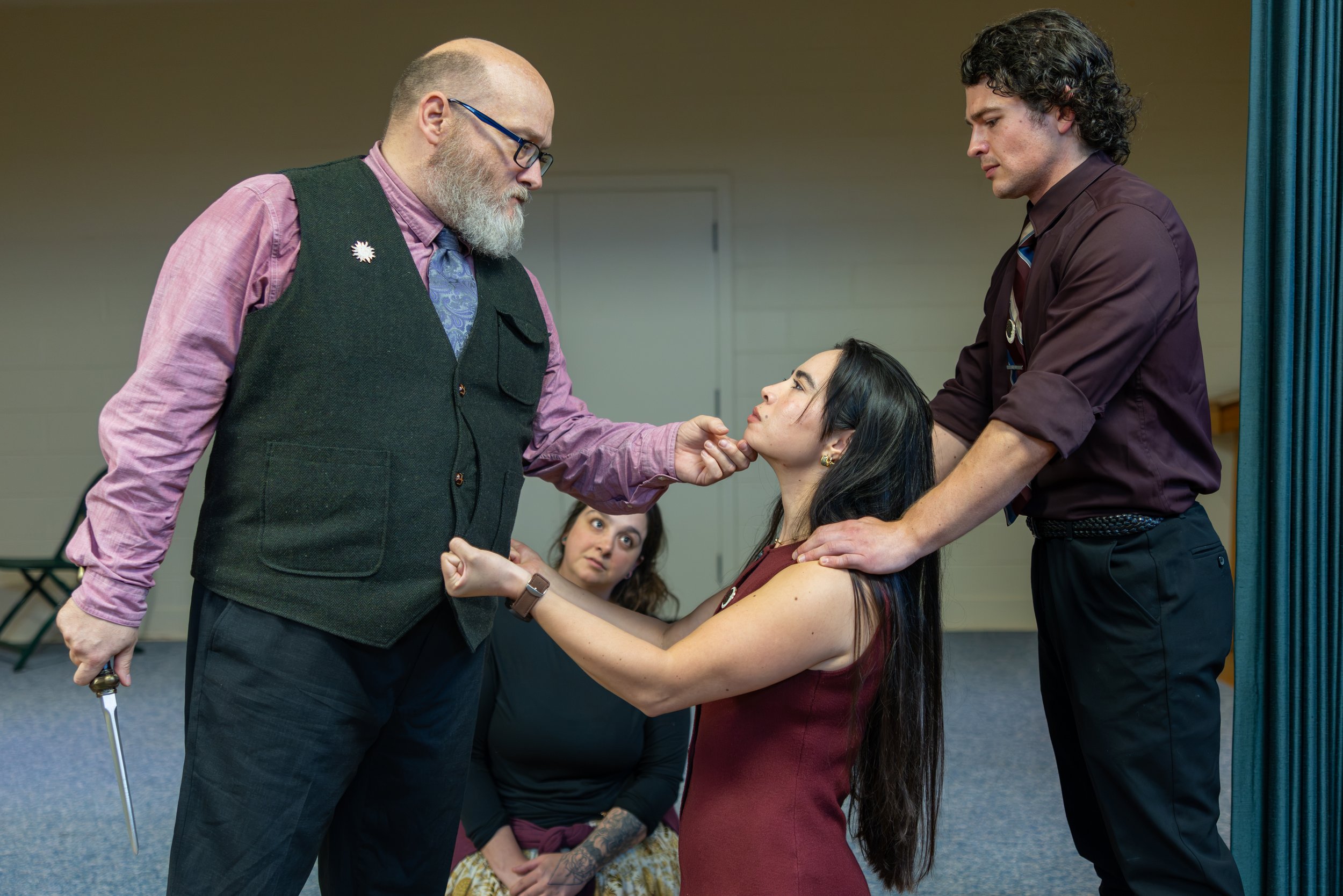
The intention of the 1:1 was to give the guest a personal moment with the founder and head of the group, gather deep lore, and have an opportunity to ask questions to get to the deepest lore. I decided from the top to never allow the Leader to lie. He could omit or ellide, but never lie. The Leader’s goal was to fill the gaps in the guest’s knowledge of the group and entice them to join (or at least consider joining).
For this this interaction to work you need: clear entry process, clear narrative ruts to allow the guest agency and space for questions without too much wandering, a clear set of possible deliverables in terms of narrative, lore, or emotional payoff and a clear exit for the scene that feels natural and not like the clock went off.
For dress rehearsal I had zero of those things. Intake was blocked by the gatekeeping cast member being needed for other things. The interactions ran to 10 minutes, were clumsy, too guest driven, had no true deliverable and a muddy exit.
We transitioned entry from a hard block through another cast member to me instigating that interaction but that added time to turnover. I soft scripted the interaction to drive the narrative more cleanly, but that limits both guest agency and my ability to personalize it to each guest’s need for the interaction. The deliverable was pinned to their interest in their first meeting and they left with a note to the Recruiter to be invited. The exit was clearer if still not on time. After the fourth performance we were only turning 6-8.
Which is underselling the experience for the guest. I intentionally failed on more personalization and attention rather than shoddier quick turns. I think of the 30ish that happened only 3-4 would say they were rushed. I successfully shrunk the space to make guests feel as though they were in an intimate space alone rather than 20 feet from 30 people on the other side of a curtain. For the more emotionally prone I think there was a real connection. And I solved for my improv gap by knowing the answers to every possible question before they showed up. The answer to not improving is simply infinity scripting.
I am excited for my second rodeo in this area. It’s still not a lot of rodeos, but knowing the mechanics better will allow more robust planning.
Story Telling Moment.
This is where my brittleness and hubris about broke the show. When we started framing the top of the show, the director and I discussed each of the cast having a storytelling moment in the night and I wrote my story to (intentionally) be longer and less conventionally beautiful to highlight the difference between the Leader and the Devoted and how being too deep in this practice can warp and bend you even in the good intentions.
I wasn’t paying enough attention to when we had moved the rest of the cast’s interactions away from storytelling, leaving me as the only story teller with a 7 minute story about child death and despair to kick off the night. That was the edited down version of the story. Told at a more aggressive pace it was four and a half minutes. I just never told it at that pace outside of the practice space. The story of overcoming bullying and child death to still seek kindness and connection in the world is something I do find beautiful and I think I told it well. But I simply didn’t have something else in my back pocket to slot in there when it become clear that it was stopping the show in its tracks and we had to restart the energy all over.
The telling doesn’t matter if it’s the wrong story and the wrong shape of story.
Audience Story Telling
This got built in to the Alchemist’s station experience and three of the four audiences had a shared story from an audience member. All three of them were highlights for me of the run, wildly successful proofs of concept for having a personal practice in seeking, cultivating, creating and sharing beauty and I think that a long residence version of this show should retain that element.
Not letting this be an Awkward Speed Date
The hyper scripting saved my butt here. The key to not allowing That Feeling into the improv scene (or speed date) is knowing what you want and wanting it badly enough to keep the scene pressurized. I had answers for every questions in the 1:1s even if the very first moment had me on my heels (my wife was my first 1:1 and her first question was an unadorned “What’s The Ritual?”) and was able to be present with each guest. With better rails planning to onboard and offboard them more cleanly I think this would have been a complete win.
But other than that Mr. Crowne how was the show?
The show went incredibly well. If you grade it on a curve I would say even better than that.
One of the things repertory companies do best is listen to each other, hear each other, and respond to each other. As a brand new company that had worked with each other in some combinations but never as a unit and never in this form. We really listened to one another and to select audience members as we broke down the show at the Blue Moon and it made a real difference. The jumps we made in terms of execution from play test to closing were herculean. I honestly thought that my wife should probably at least observe closing because they quite simply were different beasts entirely.
If you know me at all - or just got subjected to me firehosing a couple of thousand words at you about it - I love working on the bones of a thing and I love, love, love feeling the thing grow and evolve. I had a blast and am sad to not have another dozen goes at getting it a little bit more right every night.
As a model for other companies to follow I think there’s nothing more we could have asked for. Storytellers looking to build immersive, interactive, LARP or escape room shows should feel emboldened.
And lord what a rewarding exhausting way to go about telling a story.